The workshop art
How a Print Was Made
Four trades made every sheet in this house: the artist who drew, the carver who cut, the printer who rubbed each impression by hand, and the publisher who paid for all of it. What follows is the whole chain — it is also why a fine impression rewards a deep zoom.
The drawing
The artist drew the design in ink on thin paper — and then gave it up. The drawing was pasted face-down on a block of mountain cherry and carved through; the original was destroyed in the making. Every print begins with a sacrifice.
The keyblock主版
The carver cut the line drawing into the keyblock — every contour, every rain-stroke, every strand of hair, in relief, in reverse. A master carver spent years earning the right to cut faces. The keyblock printed the black line impression: the skeleton of the image, and the first thing you see in our Impressions reveal.
The color blocks色版
From keyblock proofs, the artist marked where each color would sit, and the carver cut one block per color — five, ten, sometimes twenty. Registration marks (kentō) cut into each block let the printer land every sheet in exact register, by eye and hand, thousands of times.
The baren馬連
No press. The printer laid dampened washi over the inked block and rubbed the back with the baren — a coil of bamboo cord in a bamboo-leaf jacket. Pressure, moisture, and pigment load were all judgment. The printer’s wrist is in every sheet.
Bokashiぼかし
The gradients — a sky deepening toward the horizon, a river shading into dusk — were not carved. The printer wiped pigment across the block by hand for every single impression. No two bokashi are identical; it is the reason impression variance is a feature, not a flaw.
Karazuri & kirazuri空摺・雲母摺
The luxury effects: karazuri, printing with no ink at all — pure pressed relief, a pattern you find only in raking light; and kirazuri, grounds dusted with mica so a portrait glitters out of darkness. Sharaku’s actors and Utamaro’s beauties owe half their drama to ground mica.
The publisher版元
None of this happened without the hanmoto — the publisher who chose the subject, hired artist, carver, and printer, financed the blocks, and took the risk. Tsutaya Jūzaburō staked his house on an unknown named Sharaku; Watanabe Shōzaburō rebuilt the whole system for the shin-hanga masters. The print was a workshop art. Naming the workshop is the provenance story.
See it in the prints
These sheets carry the techniques above — open one and enter the deep zoom.
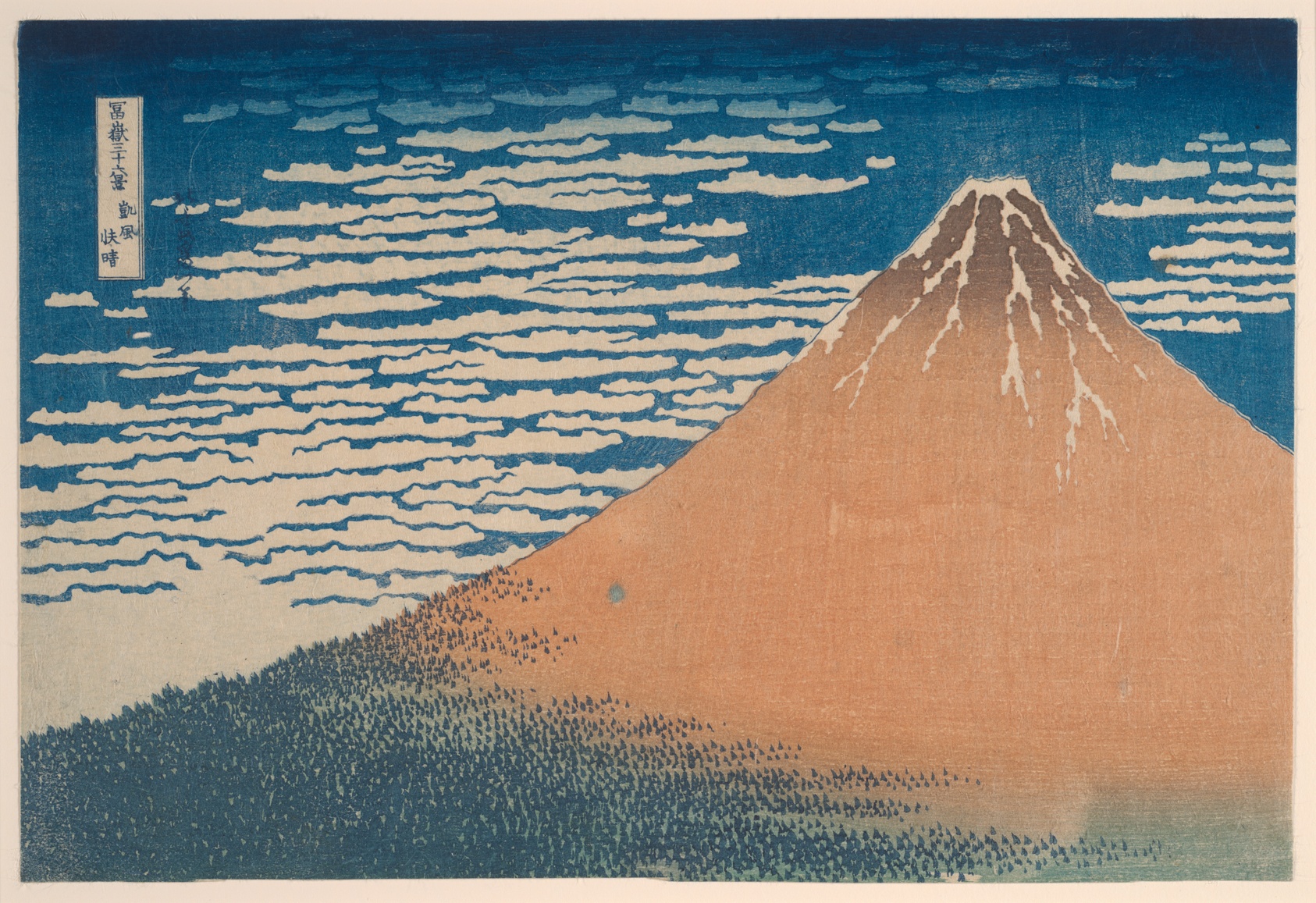 Thirty-six Views of Mount Fuji (Fugaku sanjūrokkei)Fine Wind, Clear Morning (Red Fuji)Katsushika Hokusai · c. 1830–32
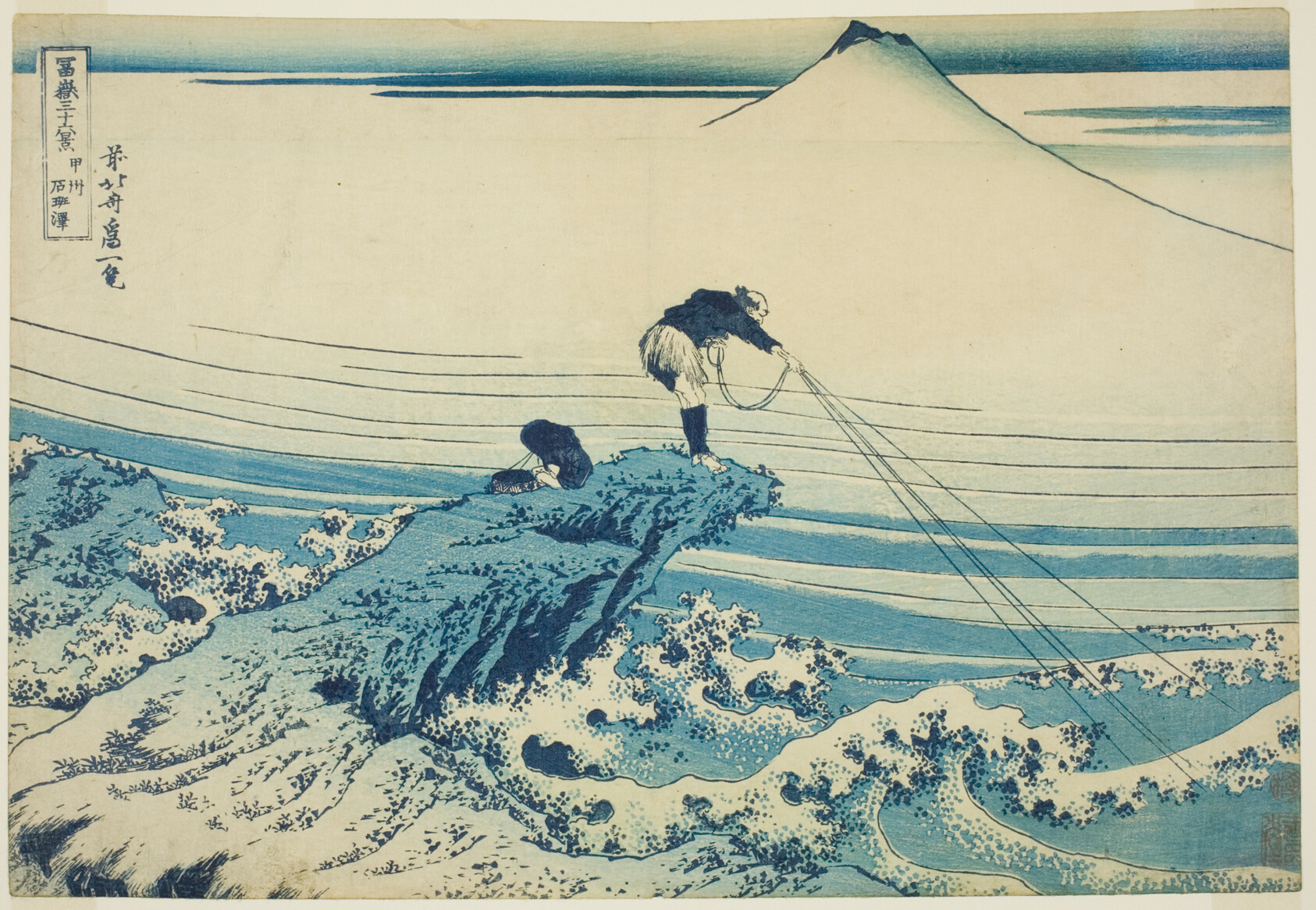 Thirty-six Views of Mount Fuji (Fugaku sanjūrokkei)Kajikazawa in Kai ProvinceKatsushika Hokusai · c. 1830–32
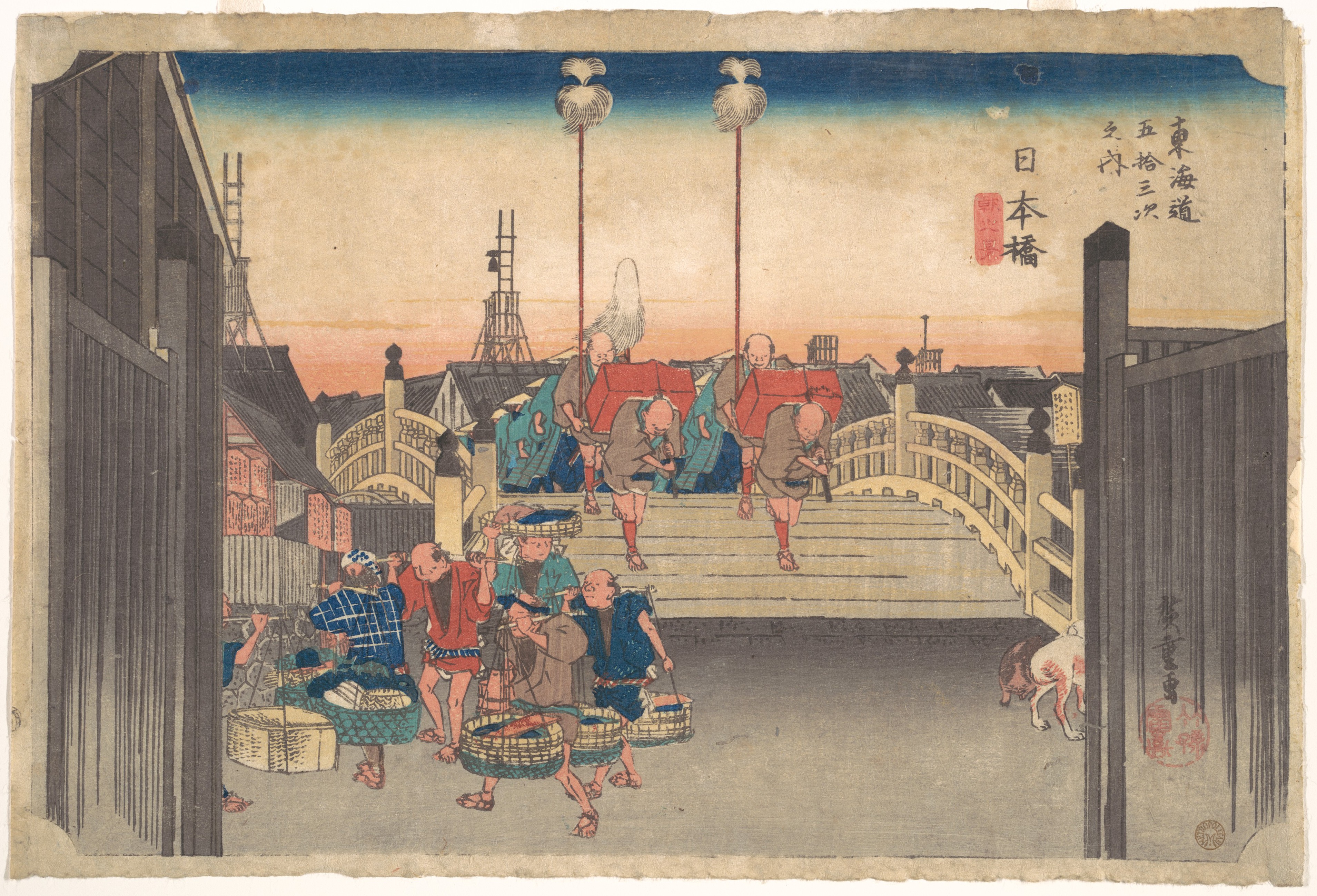 Fifty-three Stations of the Tōkaidō (Hōeidō edition)Nihonbashi: Morning SceneUtagawa Hiroshige · c. 1833–34
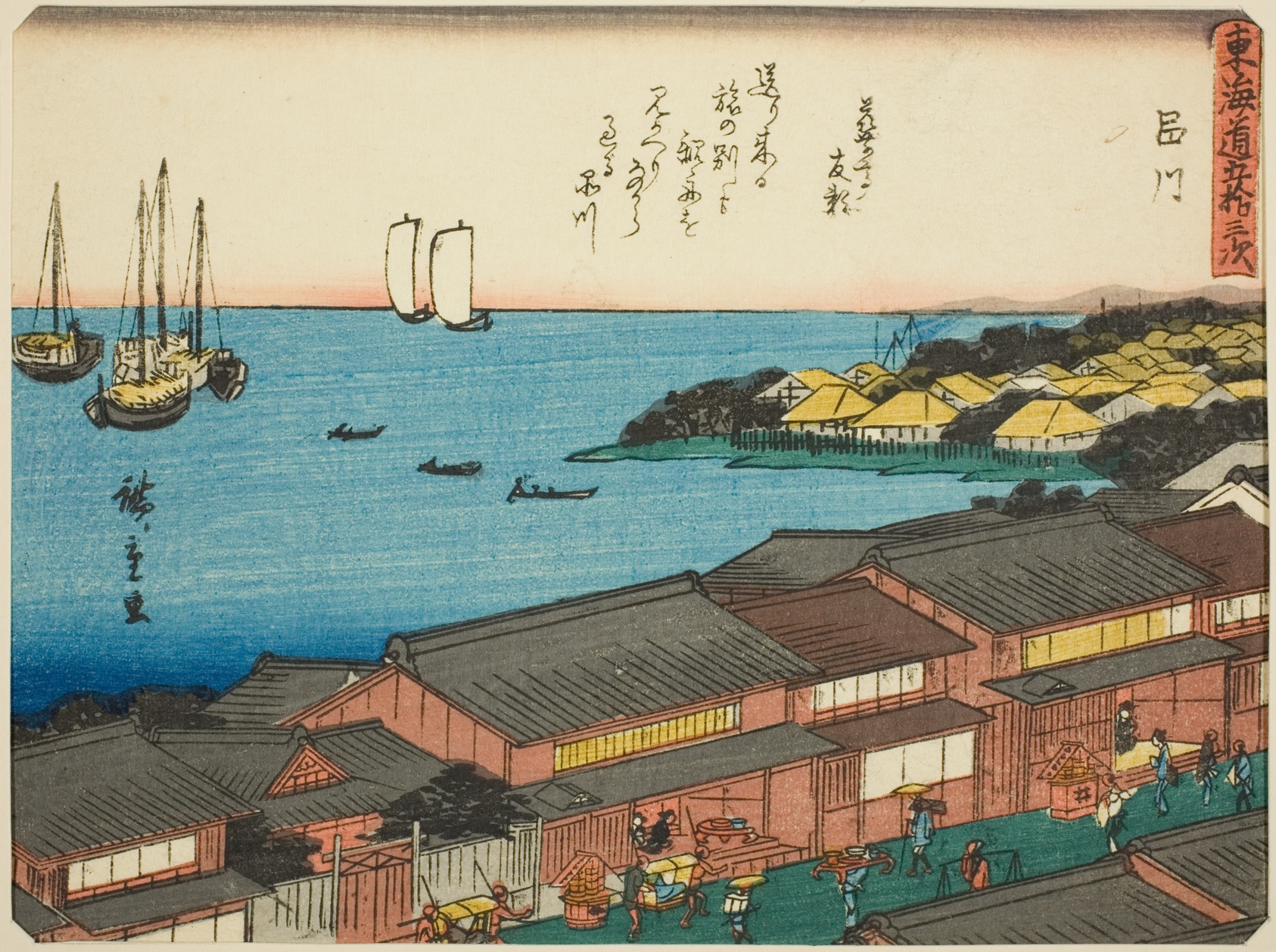 Fifty-three Stations of the Tōkaidō (Hōeidō edition)Shinagawa: SunriseUtagawa Hiroshige · c. 1833–34
Ready to walk the road? Enter the gallery →